


- Overview
- Downloads
NEMA Motors for Commercial and Industrial Applications
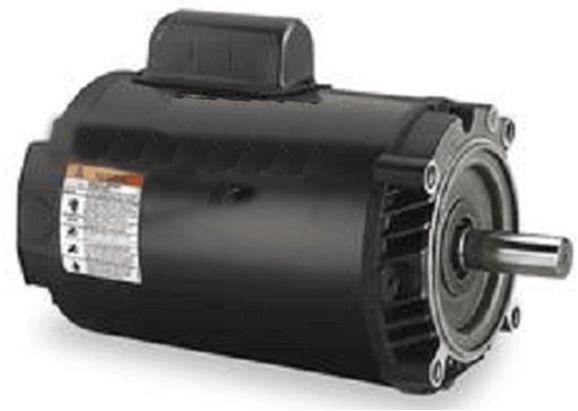
Nidec offers NEMA motors through the U.S. MOTORS® brand for pumps, fans, compressors, cooling towers and other commercial and industrial equipment. The portfolio includes open and enclosed designs for a range of operating conditions, as well as engineered-to-order (ETO) motor options when a standard configuration does not meet an application's needs.
Efficiency requirements are changing. The U.S. Department of Energy (DOE) has updated its standards for certain electric motors. The new requirements apply to affected motors manufactured in or imported into the United States beginning June 1, 2027.
What Changes for Electric Motors in 2027? 
The required efficiency level depends on the motor type, horsepower, speed (2, 4, 6, 8 pole) and voltage. Some motors will need to meet a higher minimum; other motor types will have a federal minimum efficiency requirement for the first time.
| Motor Category & Horsepower | 2027 DOE Efficiency Requirement |
|
NEMA ODP | TEFC | XP motors (100-250 hp) |
NEMA Premium® 4 |
| Standard-frame air-over motors (100-250 hp) | NEMA Premium 4 |
| Standard-frame air-over motors (1-75 hp) | NEMA Premium® |
| Industrial motors (500-750 hp) | NEMA Premium |
| Specialized or down-framed air-over motors (1-20 hp) | NEMA Energy Efficient |
This table provides a high-level summary. Requirements vary based on motor design, frame, enclosure and pole configuration. Review the detailed DOE requirements and efficiency tables.
What Does the 2027 Compliance Date Mean for Customers?

The updated requirements do not require customers to replace motors that are already operating.

Covered motors manufactured or imported before June 1, 2027, may continue to be sold if they complied with the requirements in effect at that time.
The updated requirements apply to specific motor types and horsepower ranges. Customers should review individual applications to determine whether a motor falls within the scope of the rule.
Equipment being designed now may be manufactured after the compliance date. Reviewing motor requirements early can help customers account for the new efficiency levels in future specifications.
How is Motor Efficiency Measured?
Motor efficiency is the percentage of electrical power a motor converts into useful mechanical power. A higher percentage means less energy is lost within the motor.
The International Electrotechnical Commission (IEC) uses IE classes to describe efficiency levels. In the United States, the National Electrical Manufacturers Association (NEMA) uses terms such as NEMA Premium and NEMA Premium 4.
| IEC Class | NEMA Level / U.S. Terminology |
| IE1 | Standard Efficiency |
| IE2 | NEMA Energy Efficient |
| IE3 | NEMA Premium |
| IE4 | NEMA Premium 4 |
These are broad comparisons. The exact efficiency required for a motor must be checked against the applicable DOE requirement.
What NEMA Premium 4 Means for Motor Selection
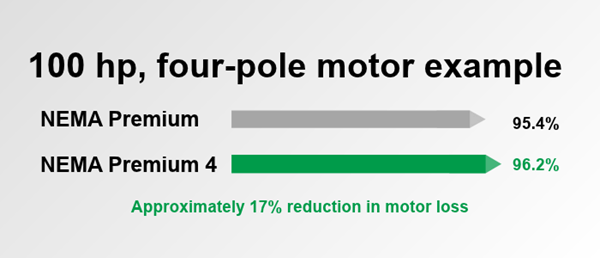
NEMA Premium 4 is a higher motor efficiency level than NEMA Premium and is broadly comparable to the international IE4 class. The 100 hp, four-pole example below shows how a small increase in nominal efficiency can reduce the share of electrical input lost as heat by approximately 17%, potentially lowering operating temperatures and helping extend motor life.
What could this mean for an application?
Energy use and operating cost.
Lower motor losses can reduce electricity use, especially in applications with long operating hours. Actual savings depend on the motor’s load, run time and electricity rate.
Starting and electrical components.
Some higher-efficiency motor designs may have different starting-current characteristics. The selected motor should be considered alongside its starter or drive, electrical protection and other supporting components.
Equipment performance and fit.
For a pump, fan or other driven load, customers should confirm the selected motor’s speed, performance, dimensions and mounting. A higher efficiency rating alone does not establish that a motor is a direct replacement in every application.
Reviewing these details while specifying equipment can help customers identify application needs and supporting equipment changes early. Nidec, through the U.S. MOTORS brand, can help customers review motor requirements and plan future specifications.